12 hours · Engr. Sarosh Ahmad
$1.00
The course is delivered through a private YouTube video link, shared separately after purchase.
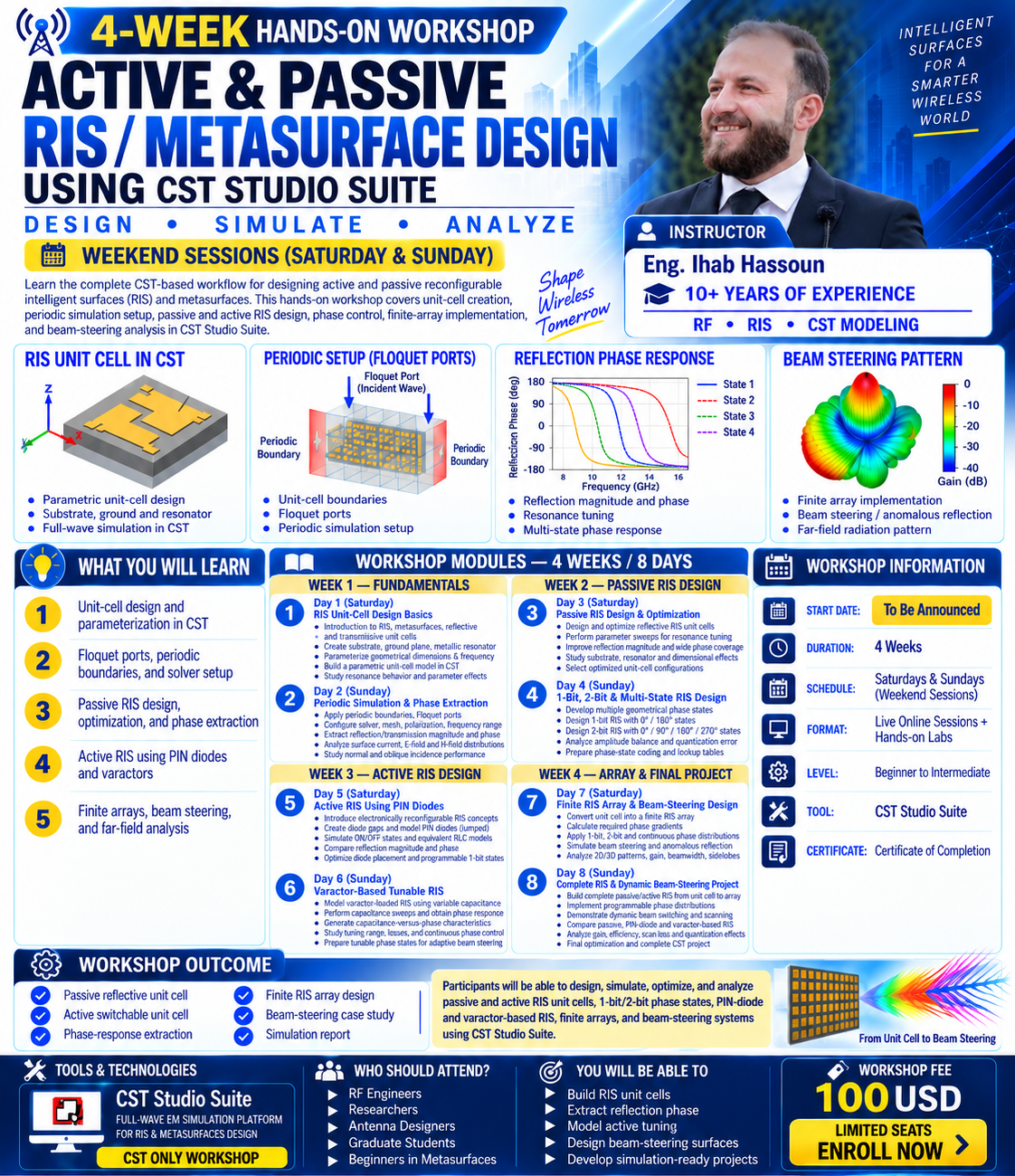
📡 4-Week CST Workshop: RIS, Active Metasurfaces & Beam Steering
━━━━━━━━━━━━━━━━━━
🗓️ WEEK 1
🔹 Day 1 – Saturday
RIS Unit-Cell Design Basics
• Introduction to RIS, metasurfaces, reflective and transmissive unit cells
• Create substrate, ground plane, metallic resonator, and define material properties
• Parameterize important geometrical dimensions and operating frequency
• Build a complete parametric RIS unit-cell model in CST
• Study resonance behavior and the effect of geometrical parameters
🔹 Day 2 – Sunday
Periodic Simulation & Phase Extraction
• Apply periodic boundaries, Floquet ports, and plane-wave excitation
• Configure solver, mesh settings, polarization, and frequency range
• Extract reflection/transmission magnitude and phase
• Analyze surface current, electric field, and magnetic field distributions
• Study normal and oblique incidence performance
━━━━━━━━━━━━━━━━━━
🗓️ WEEK 2
🔹 Day 3 – Saturday
Passive RIS Design & Optimization
• Design and optimize reflective RIS unit cells
• Perform parameter sweeps for resonance and phase tuning
• Improve reflection magnitude and obtain wide phase coverage
• Study substrate, resonator, and dimensional effects on RIS performance
• Select optimized unit-cell configurations for array implementation
🔹 Day 4 – Sunday
1-Bit, 2-Bit & Multi-State RIS Design
• Develop multiple geometrical phase states
• Design 1-bit RIS with phase states
• Design 2-bit RIS with states
• Analyze amplitude balance, phase difference, and quantization error
• Prepare phase-state coding and lookup tables for beam steering
━━━━━━━━━━━━━━━━━━
🗓️ WEEK 3
🔹 Day 5 – Saturday
Active RIS Using PIN Diodes
• Introduce electronically reconfigurable RIS concepts
• Create diode gaps and model PIN diodes using lumped/discrete elements
• Simulate ON/OFF states and equivalent RLC models
• Compare reflection magnitude and phase for different diode states
• Optimize diode placement and develop programmable 1-bit RIS states
🔹 Day 6 – Sunday
Varactor-Based Tunable RIS
• Model varactor-loaded RIS using variable capacitance
• Perform capacitance sweeps and obtain tunable reflection-phase response
• Generate capacitance-versus-phase and magnitude characteristics
• Study tuning range, losses, and continuous phase control
• Prepare tunable phase states for adaptive beam-steering applications
━━━━━━━━━━━━━━━━━━
🗓️ WEEK 4
🔹 Day 7 – Saturday
Finite RIS Array & Beam-Steering Design
• Convert the optimized unit cell into a finite RIS array
• Calculate required phase gradients for desired steering directions
• Apply 1-bit, 2-bit, and continuous phase distributions across the array
• Simulate beam steering, anomalous reflection, and multiple steering angles
• Analyze 2D/3D patterns, main-beam direction, gain, beamwidth, and sidelobes
🔹 Day 8 – Sunday
Complete RIS & Dynamic Beam-Steering Project
• Build a complete passive/active RIS from unit cell to finite array
• Implement programmable phase distributions for different beam directions
• Demonstrate dynamic beam switching and beam scanning in CST
• Compare passive, PIN-diode, and varactor-based RIS performance
• Analyze gain, efficiency, scan loss, sidelobes, and phase quantization effects
• Final optimization, result extraction, and complete CST beam-steering project
━━━━━━━━━━━━━━━━━━
✅ Workshop Outcome:
Participants will be able to design, simulate, optimize, and analyze passive and active RIS unit cells, 1-bit/2-bit phase states, PIN-diode and varactor-based RIS, finite arrays, and beam-steering systems using CST Studio Suite.
NOTE: You can send your Payment Screenshot on WhatsApp: +1(514)605-3886
Reviews
There are no reviews yet.